
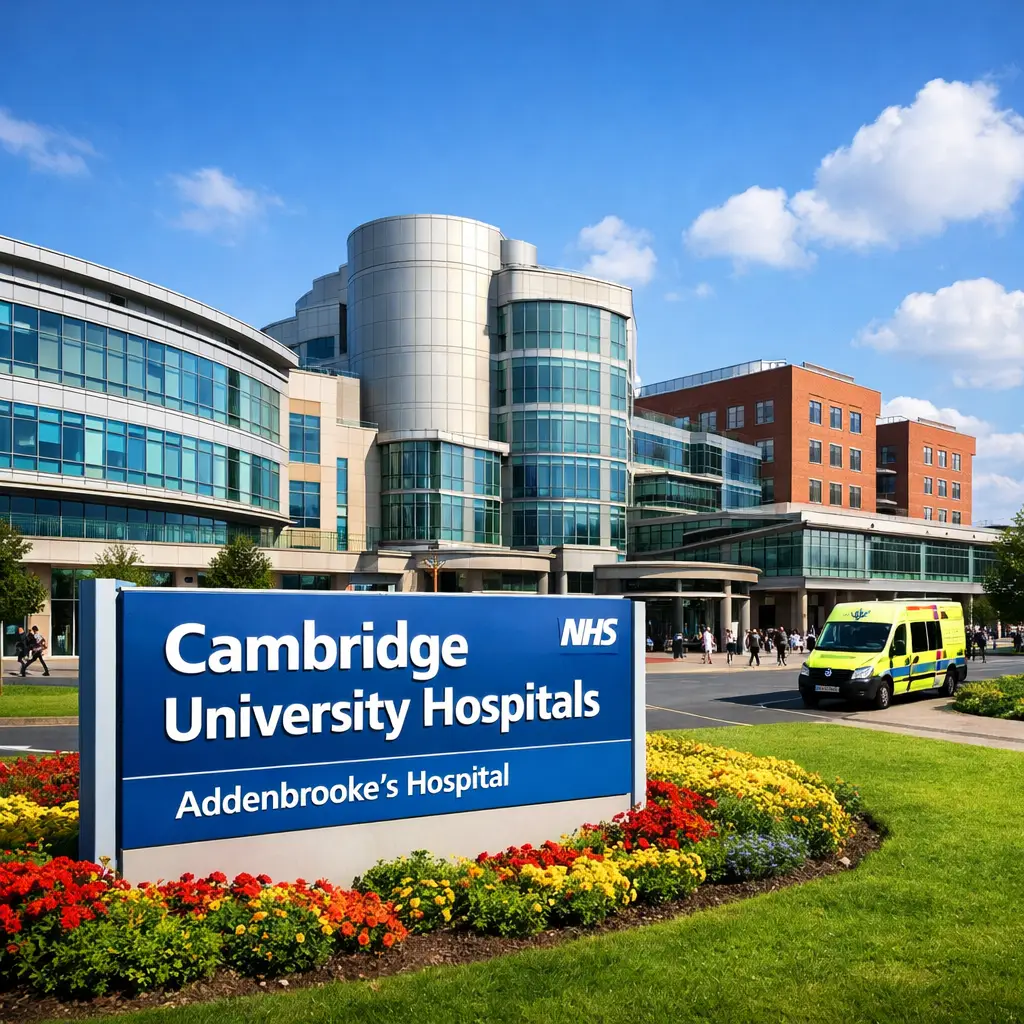
Cambridge University Hospital
Cambridge University Hospital is an NHS Foundation Trust established to provide leading-edge teaching and healthcare services. It operates hospitals such as Addenbrooke’s Hospital and The Rosie Hospital.
Establishment
It was established in 2004, following the attainment of NHS Foundation Trust status. From its inception, the vision for this hospital was to provide high-quality healthcare and medical education. This hospital is recognized as one of Britain’s premier teaching hospitals and operates under the aegis of the National Health Service.Following its establishment, the hospital gradually began to expand and enhance its modern medical services.
History
The history of this hospital dates back a considerable time. Initially, the hospital possessed only limited equipment and bed capacity. An affiliated institution—Addenbrooke’s Hospital—was established in 1766; it is regarded as Britain’s oldest teaching hospital.From the 20th century onwards, the hospital began to witness a gradual evolution in both its modern equipment and healthcare services, marked by the introduction of modern operating theaters and advanced medical machinery.
Infrastructure and Facilities
Infrastructure
This hospital features a modern building, state-of-the-art operation theaters, a modern ICU, and various other modern amenities. It serves as a hub for education, patient care, and medical research—a combination that further enhances its modernity.
Here, doctors, scientists, and students collaborate to work on developing new treatment methodologies.
High-quality waiting areas have also been provided for the family members accompanying patients.
Facilities
The facility offers emergency services, advanced diagnostic services, and specialized treatment centers dedicated to providing exceptional care to patients.
Specialized treatment facilities are available here for cardiac ailments, cancer, trauma injuries, organ transplants, neonatal care, and various other medical conditions.
The Rosie Hospital, located on the premises, is dedicated to the care and treatment of newborns.
In addition to the above, the hospital provides pharmacy services, a medical imaging center, day-care treatment facilities, advanced modern laboratories, and a team of experienced doctors who remain on duty 24 hours a day to attend to patients.
Departments and Specializations
Neurology
This department addresses issues related to the brain, spinal cord, nerves, and the nervous system. It involves the diagnosis and treatment of conditions such as stroke, epilepsy, Parkinson’s disease, multiple sclerosis, and other complex neurological disorders.
Oncology
This department is specifically dedicated to addressing critical diseases, particularly cancer. Utilizing techniques such as chemotherapy, radiotherapy, and immunotherapy, it provides treatment for various types of cancer, including breast cancer, blood cancer, lung cancer, and other malignancies.
Cardiology
This department is established to treat heart-related ailments. It provides treatment for critical conditions such as irregular heartbeats, heart failure, and heart attacks.
The specialist physicians here are capable of providing treatment through both surgical and non-surgical methods.
Doctors and Staff
1. Doctor Qualifications
The doctors at this hospital hold an MBBS degree or an equivalent medical qualification. Subsequently, they undergo advanced training in specialized fields such as Cardiology, Surgery, or General Medicine. Furthermore, to practice at this hospital—and within the UK in general—doctors are required to register with the GMC (General Medical Council). Only upon completing this registration are they authorized to work in UK hospitals.
2. The Role of Doctors
The doctors at this hospital thoroughly examine patients to diagnose their ailments, after which they prescribe appropriate medications. If a patient’s condition is critical, they recommend surgical intervention. They determine the correct course of treatment by carefully reviewing the patients’ medical reports and test results. Additionally, they provide guidance and instructions to other hospital staff members regarding patient care.
3. Qualifications and Role of Nursing Staff
The nurses at this hospital play a pivotal role in patient care. To work at this facility, nurses must possess a degree such as a B.Sc. in Nursing or a relevant diploma, and they are required to be registered nurses. The nursing staff at this hospital maintain constant, daily vigilance over the patients; they guide patients on when and how to take their medications and regularly update the doctors regarding the patients’ medical status.
4. Qualifications and Role of Technicians
The technicians at this hospital hold academic degrees related to Medical Laboratory Sciences or Health Technology. Their responsibilities include conducting laboratory tests, operating equipment such as X-ray and CT scan machines to perform diagnostic examinations, and following these procedures generating reports to be submitted to the doctors.
Patient Care Services
1. OPD Service
The OPD (Outpatient Department) is a section of the hospital where patients can receive medical treatment from a doctor without requiring admission. Patients first complete their registration, after which they are granted an appointment to see a doctor. Patients consult with the doctor to seek advice regarding their ailments. The department houses various medical specialists—including experts in cardiology (heart diseases), orthopedics (bone diseases), dermatology (skin diseases), and ophthalmology (eye diseases)—who provide specialized treatment. Initially, the doctor examines the patient, then prescribes diagnostic tests and medication. Furthermore, if the medical condition is deemed sufficiently severe, the patient may be admitted to the hospital for inpatient care.
2. Ambulance Service
Ambulance services are also available at this hospital. This service is provided to patients who require immediate transportation to the hospital. The ambulances operated by this hospital are equipped with oxygen supplies, vital-sign monitors, and other life-saving medical equipment. Trained paramedics begin administering primary medical aid to the patient while en route to the hospital, thereby ensuring that the patient’s condition does not deteriorate and remains stable.
3. Pharmacy Service
The Pharmacy Department plays a crucial role within the hospital, as it is the facility responsible for dispensing the appropriate medications to patients. Here, pharmacists verify all the medications prescribed by the doctor and provide patients with detailed instructions on how and when to take them. The Pharmacy Department also plays a vital role in ensuring that patients receive safe and accurate medications, thereby facilitating their speedy recovery.
Technology and Equipment
1. Modern Medical Equipment
To begin with, regarding the hospital itself, it utilizes state-of-the-art medical machinery—such as MRI scanners, CT scanners, digital X-ray units, and ultrasound machines. These devices clearly display internal bodily conditions and ailments on digital monitors, enabling doctors to provide a rapid and accurate diagnosis. Furthermore, the operating theaters are equipped with advanced surgical instruments and robotic technology to ensure that surgeries are performed with maximum safety and precision. The ICU features ventilators and patient monitoring systems that continuously track and display vital parameters such as the patient’s heart rate, blood pressure, and oxygen levels.
2. Digital Record System
This hospital maintains patient records digitally, a system referred to as EPR (Electronic Patient Records). This ensures that all patient-related information—including medical history, test results, prescribed medications, and doctors’ recommendations—is securely stored within the hospital’s computer systems. Consequently, doctors and nurses can access a patient’s complete medical profile at any time, thereby facilitating faster and more accurate treatment. Moreover, the implementation of this digital record system significantly reduces the need for paper-based files.
3. Telemedicine
The hospital also offers telemedicine services. Telemedicine is a facility that allows patients to consult with doctors regarding their health concerns online, even when they are physically located far away from the hospital. Doctors listen to patients’ issues via video calls or mobile applications and, based on that assessment, prescribe appropriate medications. Additionally, some patients are provided with remote monitoring devices; these devices continuously transmit the patient’s health data back to the hospital, regardless of whether the patient is at home or traveling elsewhere.
Community and Social Works
This medical institution provides not only medical services but also undertakes extensive work in the field of social welfare. Its main hospital campus is situated at Addenbrooke’s Hospital, from where numerous community programs are administered.
Community Work
This initiative focuses on health awareness, disease prevention, and improving the standard of living for local residents. The hospital conducts various health programs and organizes free camps, which include medical screenings and check-ups. The primary objective of these programs is to encourage people to adopt a healthy lifestyle, recognize disease symptoms early, and seek timely medical treatment.
Social Works
In the realm of social work, the CUH Social Work Team provides emotional, social, and practical support to patients and their families. The team offers psychological support to patients and facilitates their connection with various government assistance schemes, rehabilitation services, and community organizations. Consequently, patients receive enhanced support even beyond their hospital stay.
The hospital’s staff and doctors collaborate with local residents to organize various community programs, and the medical and nursing teams strive to help the local population achieve a disease-free life.
Challenges and Problems
This hospital (which includes Addenbrooke’s Hospital and The Rosie Hospital) is one of the largest and most renowned medical institutions in the UK. However, operating such a massive hospital system entails facing numerous challenges and problems.
1. Increasing Patient Numbers
- In the UK, healthcare services primarily fall under the National Health Service (NHS).
- Consequently, medical treatment here is often provided free of charge or at a low cost.
2. Staff Shortages
- A shortage of doctors, nurses, and medical support staff constitutes a major problem.
3. Financial Pressures
- The NHS budget is under constant pressure.
- New machinery, medications, and technology are extremely expensive.
4. Infrastructure and Space Constraints
- Some of the buildings are quite old.
- The rising number of patients has led to:
A shortage of beds
Parking difficulties
A need for new buildings
5. Technology and Digital Transformation
- Adopting new technologies is both expensive and complex.