
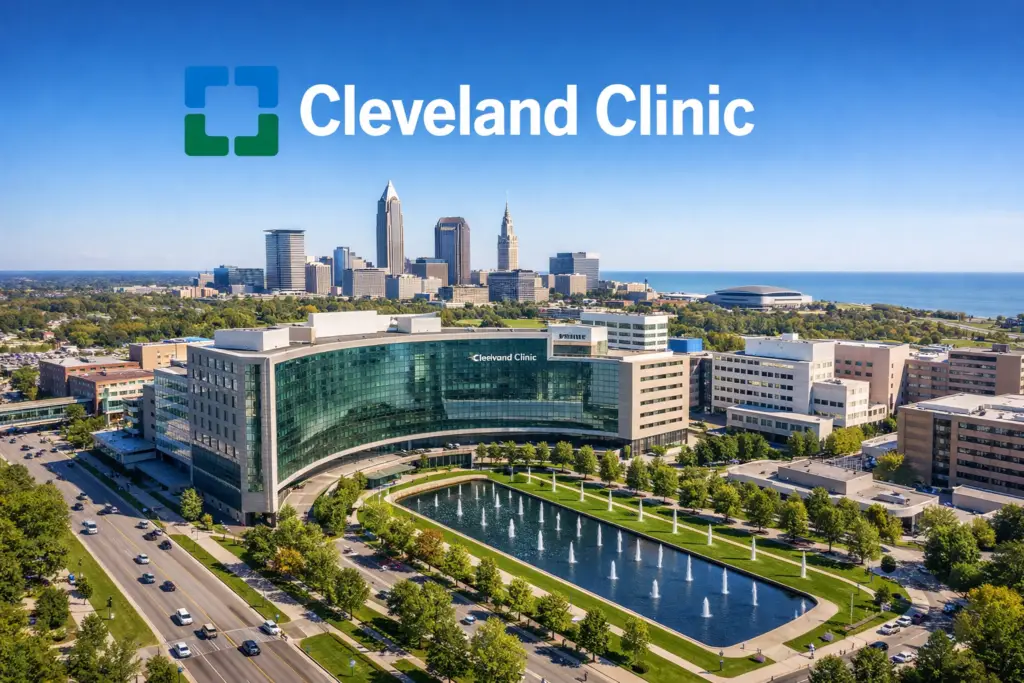
Cleveland Clinic
Establishment
Located in the city of Cleveland, USA, the Cleveland Clinic was established in 1921 through the efforts of four pioneering physicians: George Washington Crile, Frank E. Bunts, William E. Lower, and John Phillips. These doctors had treated wounded soldiers in the military during World War I. During that time, they realized that if a team of doctors worked together to treat patients, medical care could be delivered more safely, efficiently, and expeditiously.
Stemming from this concept, specialist physicians collaborate to diagnose, treat, and manage patients’ health conditions. They termed this approach the “Group Practice” model.
History
Due to its primary focus on modern medical practices and research, the hospital soon gained worldwide recognition.
In 1929, a fire broke out at the Cleveland Clinic, resulting in numerous fatalities and having a profound impact on the institution; however, in the aftermath of this tragedy, the hospital significantly strengthened its safety protocols.
Despite facing such adversities, the clinic successfully established itself as one of the premier medical institutions globally.
Infrastructure and Facilities
Infrastructure
The Cleveland Clinic encompasses extensive hospital complexes, research centers, a medical school, and core treatment units. Its buildings are designed in such a way that patient care, medical treatment, and other essential facilities are all available under a single roof.
The Cleveland Clinic features state-of-the-art operating theaters, ICUs, emergency departments, multi-story hospital buildings, and much more. In addition to its presence across several U.S. states, its medical centers are also located in international hubs such as Abu Dhabi and London.
Facilities
The facility is equipped with advanced diagnostic technologies—including CT scans, ultrasounds, MRIs, and various other testing modalities—which aid in accurately diagnosing patients’ conditions and facilitating successful treatment outcomes.
Furthermore, a dedicated waiting area is available for family members accompanying patients.
It is precisely because of these comprehensive facilities that the Cleveland Clinic is today recognized as one of the world’s premier hospitals.
Departments and Specializations
Neurology
This department specializes in the diagnosis and treatment of disorders affecting the spine, nervous system, and brain. The medical professionals in this department—including neurologists, neurosurgeons, and neuro-imaging specialists—treat complex conditions such as stroke, epilepsy, Parkinson’s disease, Alzheimer’s disease, and multiple sclerosis.
Oncology
This department caters to patients suffering from cancer. The medical team here consists of medical oncologists, surgical oncologists, and radiation specialists.
Various types of cancer—including breast cancer, lung cancer, blood cancer, and prostate cancer—are treated here using advanced techniques such as chemotherapy, radiation therapy, and immunotherapy.
Cardiology
This department focuses on the treatment of heart-related diseases; the cardiologists at this hospital are renowned globally. Heart-related conditions—such as irregular heartbeats, heart attacks, heart failure, high blood pressure, and coronary artery disease—are treated using advanced techniques including angiography, angioplasty, cardiac monitoring, and bypass surgery.
Doctors & Staff
1. Doctors’ Qualifications
The doctors at this hospital hold medical degrees such as MBBS and MD. Many of them are specialists in specific medical conditions. Their primary responsibilities include examining patients, accurately diagnosing illnesses, and administering appropriate treatment. Furthermore, when necessary, doctors also advise patients to undergo surgery.
2. Nursing Staff
The nursing staff at this hospital plays a significant role in patient care. The nurses hold qualifications such as a B.Sc. in Nursing or other relevant nursing degrees. Their main duties involve caring for patients, administering medications at scheduled intervals, monitoring the patients’ health status, and relaying all relevant patient information to the doctors.
3. Technicians
The technicians at this hospital are responsible for performing medical laboratory procedures and operating advanced medical equipment. They operate machines such as MRI scanners, CT scanners, and X-ray units, and conduct various laboratory tests to assist doctors in accurately diagnosing illnesses.
Patient Care Services
1. OPD Services
The OPD (Outpatient Department) is a hospital service where patients can consult a doctor for examination and treatment without requiring admission. Here, doctors provide consultations to patients, conduct essential diagnostic tests, and—based on the reports—prescribe medications. If the medical condition is not severe, the patient is discharged and sent home on the same day. Cleveland Clinic features a wide range of specialist doctors available for OPD consultations, including experts in fields such as cardiology (heart specialists), oncology (cancer specialists), and neurology.
2. Emergency Services
The Emergency Department at this hospital operates 24 hours a day, with doctors available around the clock. Sudden, severe illnesses or injuries are treated immediately within this department. Conditions such as heart attacks, head injuries, excessive bleeding, or respiratory distress are attended to with urgency. A dedicated team comprising doctors, nurses, and other medical staff works collaboratively to ensure that patients receive appropriate and effective treatment.
3. Ambulance Services
Cleveland Clinic Hospital offers comprehensive ambulance services. In emergency situations, ambulances are utilized to transport patients to the hospital as quickly as possible. The hospital’s ambulances are staffed by trained paramedics who administer preliminary first aid en route, ensuring that patients are delivered directly to the Emergency Ward.
4. Pharmacy
Cleveland Clinic Hospital houses various pharmacy services where patients can procure all medications prescribed by their doctors. The pharmacy staff provides patients with detailed instructions regarding the correct usage of their medications and informs them about potential side effects. Medications are available here for both inpatients (admitted patients) and outpatients. Furthermore, a dedicated team of pharmacy staff remains on duty 24 hours a day to serve the hospital’s needs.
Technology and Equipment
1. Modern Medical Equipment
The Cleveland Clinic utilizes state-of-the-art medical equipment. This hospital employs advanced machines such as MRI scanners, CT scanners, X-ray machines, and ultrasound devices. These machines enable medical professionals to visualize the interior of the human body with great precision. Consequently, this facilitates doctors in accurately identifying the underlying causes of illnesses. Furthermore, certain surgical procedures at this hospital are performed with the assistance of robotic surgery systems. In robotic surgery, the machine executes its tasks with exceptional precision, thereby making the operation safer and more efficient.
2. Digital Records
Another crucial technological feature at this hospital is the use of digital records. Historically, hospitals maintained all patient information through paper-based documentation; however, the Cleveland Clinic now securely stores comprehensive patient data within computer systems. This system is referred to as Electronic Medical Records (EMR). It serves as a repository for all patient reports, test results, X-rays, and complete treatment histories. This allows doctors to access a patient’s medical records at any time, enabling them to plan and administer subsequent treatments effectively.
3. Telemedicine
Telemedicine enables patients to consult with their doctors remotely—even from a distance. Patients can seek medical advice from doctors through online channels, such as video calls conducted via mobile phones or computers. Doctors, in turn, can review the patient’s medical reports online and provide appropriate recommendations. This technology ensures that even patients residing abroad can easily access medical services.
Additionally, the hospital makes extensive use of advanced patient monitoring systems and AI technology. These technologies continuously monitor the patient’s health status and provide doctors with real-time updates regarding the patient’s condition.
Community and Social Initiatives
This system serves not merely as a healthcare provider but also plays an active role in community development and social welfare. Its primary objective is to maintain the well-being of the populace and to disseminate information regarding health awareness and healthy living.
1. Community Health Programs
These programs are designed specifically for individuals who lack access to adequate healthcare facilities. They encompass the organization of free health screenings, vaccination drives, and disease prevention campaigns. The aim is to ensure that everyone receives timely medical check-ups, thereby preventing illnesses from escalating into critical conditions.
2. Health Education and Awareness
Through seminars, workshops, and online resources, this healthcare system disseminates health-related information within the community. Health education and awareness initiatives provide guidance on maintaining mental well-being and offer information regarding the treatment of various ailments, thereby facilitating significant improvements in patients’ lifestyles and overall health.
3. Economic Development and Social Support
The system generates employment opportunities for local residents and facilitates skill development through workforce training programs. Furthermore, the hospital extends social assistance to needy families, providing support services such as food aid, housing assistance, and transportation services.
Challenges and Problems
This is a massive healthcare system; however, it too faces numerous challenges and problems.
1. High Operational Costs
Maintaining modern medical equipment, advanced technology, research facilities, and a skilled team of doctors and staff entails significant expenditure.
Given the sheer scale of this healthcare system, patients travel from far and wide to seek treatment here. However, accommodating the large volume of patients by providing sufficient hospital beds incurs substantial costs.
2. Healthcare Workforce Shortage
Like many other hospitals, the Cleveland Clinic faces a shortage of trained nurses, doctors, and medical staff. The scarcity of personnel places immense pressure on the existing workforce, resulting in longer waiting times for patients seeking treatment.
3. Rising Patient Numbers and Complex Diseases
In recent times, the number of patients suffering from chronic diseases—such as diabetes and cancer—has been steadily increasing. Given this growing volume, providing high-quality care to every patient remains a challenging task.
Future Plans and Vision
This institution stands as one of the world’s largest non-profit academic medical centers. Its core objective is to significantly advance research and innovation within the medical field, thereby ensuring that patients receive the highest quality of care.
1. Global Expansion
- New hospitals and specialty centers are being established in regions such as the UK, Canada, Florida, and the Middle East.
- A new cancer hospital is slated to open in London by 2027, aiming to provide advanced cancer treatments to patients across Europe and the Middle East.
2. Research and Medical Innovation
Cleveland Clinic’s ambitious goal is to become a global leader in medical research.
- New research buildings (spanning approximately 300,000 sq ft) are currently under construction.
- Advanced laboratories are being developed to facilitate pathogen research and vaccine development.
3. AI, Quantum Computing, and Digital Health
- Early disease detection powered by AI.
- Collaboration with IBM to utilize quantum computing for biomedical research.
4. New Hospital and Infrastructure Development
Several major projects have been planned for the coming years:
- New Neurological Hospital (2026)
- Avon Campus Expansion (~$340 million)
- Global Peak Performance Center (2027)
5. Future Healthcare Model
- “Hospital-at-Home” programs (virtual care)
- Telemedicine
- Automation and AI-based workflows
These initiatives will help reduce the cost of treatment while making patient care more efficient.