
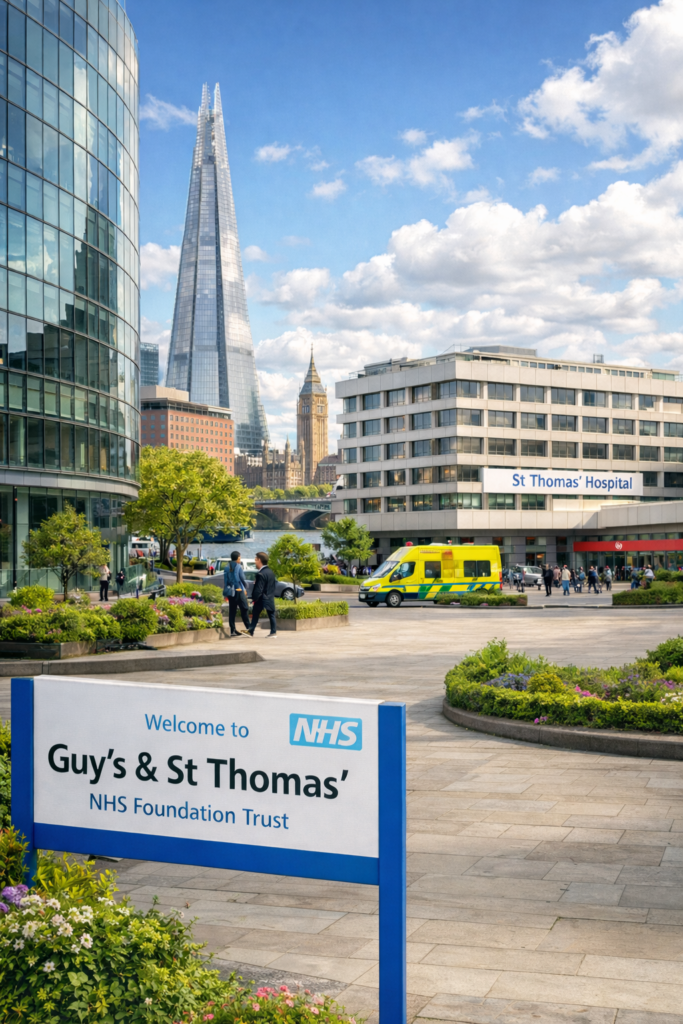
Guy’s & St Thomas’ NHS Foundation Trust
Establishment
Guy’s & St Thomas’ NHS Foundation Trust was established in London in 1993, formed through the merger of Guy’s Hospital and St Thomas’ Hospital. From its inception, the institution’s objective has been to provide superior medical care and advanced healthcare services to the public.
In 2004, the institution was granted the status of an NHS Foundation Trust. Following this milestone, the hospitals experienced accelerated growth and gained widespread renown, integrating modern systems and methodologies into their treatment protocols.
It has evolved into more than just a healthcare facility; it has also become a hub for medical education and research. Today, the institution enjoys a distinguished reputation throughout London.
History
The history of this healthcare institution within the United Kingdom spans many centuries. As is well known, the institution was formed by the amalgamation of two primary hospitals. The first of these is St Thomas’ Hospital, the origins of which are traced back to the 12th century. In that era, it functioned as a small religious infirmary dedicated to treating the ailments of the poor.
As time progressed, the hospital began to evolve, eventually transforming into a leading center for medical education and modern therapeutic treatments.
The second component is Guy’s Hospital, which was established in the 18th century. Thomas Guy played a pivotal role in its foundation; his vision was to provide superior medical care to the underprivileged.
Infrastructure and Facilities
Modern Buildings
The facility’s buildings have been constructed utilizing modern technology, with meticulous attention paid to ensuring a safe and conducive environment tailored to the needs of the patients.
A modern waiting area has also been established here for the family members accompanying the patients.
Medical Departments
Upon arrival, patients undergo an initial diagnostic assessment to ensure they receive the most effective and modern medical treatment available. Specialized departments have been established to address a wide range of ailments, including Neurology, Cardiology, Oncology, Orthopedics, and Nephrology.
Emergency Department
This department is dedicated to treating severe injuries resulting from accidents, as well as sudden-onset medical emergencies. A dedicated team of doctors and nurses remains on standby 24 hours a day to provide immediate care, supported by a fully integrated ambulance service.
ICU Department
This unit has been designed specifically for patients suffering from severe or complex medical conditions, enabling their treatment through the use of advanced medical equipment.
The facility is equipped with state-of-the-art machinery, including ventilators and heart monitoring systems.
Departments and Specializations
Neurology
This department is dedicated to the treatment of conditions affecting the brain, spinal cord, and nervous system—such as strokes, epilepsy, and Parkinson’s disease.
Facilities such as X-rays, CT scans, and MRIs are available within this department to aid in the diagnosis of these conditions.
Oncology
This department has been established to combat complex diseases such as cancer. It provides treatment for conditions including breast cancer, lung cancer, and blood cancer, utilizing therapies such as chemotherapy, radiotherapy, and surgery.
Cardiology
This department is dedicated to the treatment of heart-related conditions, including heart attacks, heart failure, irregular heartbeats, and various other cardiac disorders.
Nephrology
This department focuses on the treatment of kidney-related diseases. The services provided within this department include dialysis and kidney transplantation.
Orthopedics
This department is dedicated to the treatment of conditions affecting the bones, joints, and muscles—such as fractures, arthritis, and joint replacement requirements.
Doctors and Medical Staff
1. Doctor Qualifications
The doctors at this hospital are highly qualified professionals who have undergone advanced medical education. To become specialists, they complete their MBBS degree followed by specialized training in their respective fields. The primary responsibility of these doctors is to conduct thorough examinations of patients and provide the best possible medical treatment; furthermore, when necessary, they also perform surgeries. This hospital houses various types of medical specialists—for instance, there are cardiologists available to treat heart patients and perform cardiac surgeries.
2. Nursing Staff
The nursing staff plays a pivotal role in the operations of this hospital. They hold academic credentials such as a B.Sc. in Nursing or a Nursing Diploma. Nurses administer medications to patients when medical issues arise, continuously monitor their condition, and provide them with emotional support. For example, following a surgical procedure, nurses provide regular care to the patient and assist them throughout their recovery process.
3. Technicians
The role of technicians involves operating the modern medical equipment installed within the hospital and performing all tasks related to diagnostic testing. Technicians possess specialized training in medical technology. Laboratory technicians, for instance, conduct various lab tests and blood analyses, while radiology technicians operate equipment such as X-ray and MRI machines.
Patient Care Services
1. OPD Services
The OPD (Outpatient Department) is a section of the hospital where patients do not require admission. Here, patients first complete their registration, after which they schedule an appointment with a doctor for a consultation. Following the examination, the doctor prescribes specific diagnostic tests and medications. Patients are typically discharged and sent home on the same day. Various medical specialists are available here to provide routine check-ups, follow-up care, and treatment for a wide range of ailments.
2. Emergency Services
The hospital’s Emergency Department operates 24 hours a day. In cases of severe illness or sudden accidents, patients are admitted directly to the Emergency Ward. Treatment commences immediately upon arrival, and the medical staff makes rapid, critical decisions to ensure the patient’s life is saved.
3. Ambulance Services
This hospital also provides ambulance services. In emergency situations, an ambulance promptly transports the patient to the hospital. Additionally, non-emergency transport services are available, offering valuable assistance to elderly or frail patients.
4. Pharmacy Services
Pharmacy services are also available within the hospital premises. Through the pharmacy service, patients can procure all medications prescribed by their doctors at reasonable rates. The pharmacy staff provides patients with accurate information regarding their medications and offers medication reviews. The hospital’s trained pharmacy professionals play a vital role in facilitating safe and effective treatment for patients.
Technology and Digital Equipment
1. Advanced Medical Machinery
This hospital is equipped with a wide variety of modern medical machines. Diagnostic procedures such as CT scans, X-rays, PET scans, and MRIs are performed here, which aid in identifying a patient’s ailment as quickly as possible. Furthermore, various smart tools and AI-driven technologies are utilized to assist doctors in providing effective treatment to patients.
2. Digital Records
This hospital employs a digital records system. This means that a patient’s complete medical history—including medical check-up results and medication details—is securely stored on computers. Consequently, doctors, nurses, and other medical staff can easily access a patient’s medical reports with just a single click. This facilitates faster and more accurate treatment.
3. Telemedicine
Telemedicine facilities are also available at this hospital. Through telemedicine, patients can consult with a doctor and undergo a virtual check-up via video call, whether they are at home or traveling elsewhere. This service also helps save time. This facility is particularly beneficial for individuals residing abroad or for elderly patients.
Community and Social Work
This Trust is a major healthcare institution based in the United Kingdom. In addition to hospital services, the Trust places a special emphasis on social work. The objective of this Trust is to extend its services beyond the confines of the hospital, reaching out into the community to provide care through various social initiatives.
1. Community Services
The Trust aims to deliver healthcare services at the community level through social outreach, ensuring that patients receive appropriate treatment within their immediate neighborhoods. These services include nursing care, physiotherapy, and rehabilitation. This approach eliminates the need for patients to travel to a hospital, allowing them to receive high-quality care within the familiar environment of their own homes.
2. Social Work
The social workers associated with this Trust play a pivotal role; they possess a deep understanding of the social and economic needs of both the patients and their families. By carefully assessing the challenges faced by patients, these social workers are able to facilitate the provision of appropriate support and resources.
3. Teamwork
The doctors, nurses, and social workers at this hospital work collaboratively. This integrated approach ensures that patients and those in need receive comprehensive and holistic assistance.
Challenges and Problems
1. Increasing Number of Patients
The rising number of elderly patients leads to a host of challenges. Frequently, the hospital faces issues such as a shortage of beds. This places an increased strain on the hospital’s resources and operations.
2. Staff Shortage
A scarcity of doctors, nurses, and general hospital staff constitutes a major problem for this trust. Due to the limited workforce, the workload and pressure on the existing doctors and staff members intensify. Consequently, patients are unable to receive comprehensive care.
3. Financial Constraints
Financial instability is another significant challenge. Due to a limited budget, patients often face considerable difficulties. Poor patients, in particular, find the cost of medicines and medical treatment to be prohibitive—a direct consequence of the restricted budget.
4. Technological Challenges
Training is essential for operating modern medical technology. Providing adequate training to the staff members to handle these advanced systems presents a significant challenge in itself.
Future Plans and Vision
The primary objective of this Trust in the future is to ensure that patients have access to rapid, superior, and affordable medical treatment.
1. Enhanced Healthcare Services
This Trust aims to provide patients with high-quality, prompt medical care, placing a strong emphasis on improving the patient experience and enhancing the efficacy of treatment. The goal is to ensure that all patients receive timely, rapid, and excellent medical attention.
2. Improvement in Public Health
In the future, the Trust aspires to go beyond merely treating illnesses; it intends to collaborate with various communities to conduct programs aimed at educating people about disease prevention. This initiative seeks to enable everyone to lead a healthy and better life.
3. Infrastructure and Sustainability
The Trust is currently investing in infrastructure and modern technology, while simultaneously developing eco-friendly systems. This strategic approach will ensure that, in the times to come, people continue to receive convenient and accessible medical care.