
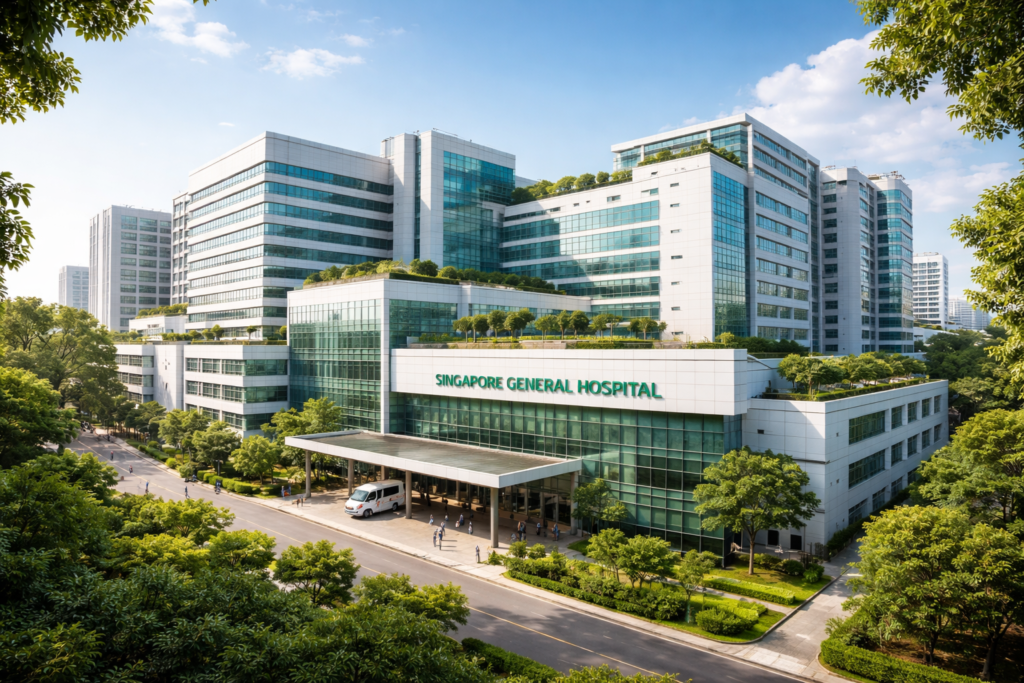
Singapore General Hospital
Establishment
Singapore General Hospital was established in 1821. At that time, it was a small hospital with limited medical equipment and facilities. As Singapore gradually evolved into a developed trading nation, the demand for medical services within the country continued to rise. In 1882, the hospital was re-established on Outram Road. This new location was spacious and well-developed, a factor that significantly contributed to its medical advancement.
History
This hospital ranks among the oldest hospitals in Asia. Initially, the hospital was established solely to provide healthcare services to British soldiers and local residents; however, it began to undergo significant development during the 19th century. As Singapore’s population grew, the demand for medical services also continued to increase. In the early 20th century, Singapore General Hospital began adopting modern medical equipment and advanced healthcare services.
Infrastructure and Facilities
Infrastructure
The infrastructure of this hospital is remarkably modern, a distinction that places it among the world’s leading and most advanced medical institutions. The hospital’s main campus is situated on Outram Road; its building features a contemporary design and offers state-of-the-art facilities.
Dedicated blocks have been constructed here to cater to patients with various medical conditions, housing departments such as Surgery, Emergency Services, and specialized treatment centers. In addition to these, the facility is equipped with modern operation theaters, advanced ICUs, and high-tech diagnostic laboratories.
Facilities
At this hospital, a dedicated team of doctors and nurses remains on standby 24 hours a day, ready to attend to patients.
In addition to services such as MRI, CT scans, and advanced laboratory testing, the hospital offers specialized medical services including Cardiology, Neurology, Oncology, and Orthopedics.
Departments or Specializations
Various departments dedicated to different medical conditions are available here, where diseases are diagnosed and treated.
Oncology
This department provides treatment for cancer-related conditions—such as breast cancer and lung cancer—through chemotherapy, radiotherapy, and surgery.
Cardiology
This department addresses all heart-related conditions—including heart failure, heart attacks, irregular heartbeats, and other cardiac ailments—utilizing treatments such as angioplasty, heart surgery, ECG, and echocardiograms.
Gastroenterology
This department specializes in the treatment of conditions affecting the digestive system, such as abdominal pain, ulcers, and disorders related to the liver and intestines.
Nephrology
This department focuses on the diagnosis and management of kidney-related issues—including kidney failure and urinary tract disorders—and provides treatments such as dialysis.
Pulmonology
This department provides treatment for all lung-related conditions, such as asthma, tuberculosis (TB), and respiratory difficulties.
In addition to the above, other departments—including Dermatology and Endocrinology—are also available here.
Doctors and Staff
1. Doctor Qualifications
The doctors at this hospital serve as the primary decision-makers in any situation. They hold MBBS degrees and specialize in specific medical fields and organ systems—such as cardiology, neurology, and surgery. Their initial step involves examining the patient to identify the underlying cause of the illness. Subsequently, they prescribe medications tailored to the specific condition; if the situation is critical, they recommend surgery and outline a comprehensive treatment plan. Senior doctors and consultants provide guidance to the junior medical staff.
2. Nursing Staff
The nursing staff at this hospital plays a pivotal role in patient care. They provide round-the-clock care, which includes administering medications and injections, setting up IV drips, monitoring blood pressure and oxygen levels, maintaining hygiene, and ensuring the patient’s comfort. The nurses educate both the patient and their family members regarding the illness and the necessary care protocols, instilling hope and assurance that the patient will make a speedy recovery.
3. Technicians and Allied Staff
The technical staff at this hospital performs various specialized functions. Laboratory technicians conduct diagnostic tests on blood and urine samples, while the radiology staff operates equipment such as X-ray machines, CT scanners, and MRI scanners. Surgical technicians prepare the instruments required for operations, and physiotherapists contribute significantly to the patient’s recovery process.
Patient Care Services
1. OPD Service
The OPD (Outpatient Department) is a section of the hospital dedicated to patients who do not require admission. Here, patients first register themselves and then schedule an appointment with a doctor. Based on this appointment, they undergo an examination by a specialist; subsequently, the doctor prescribes medication tailored to their specific ailment, and the patients are discharged to return home on the very same day.
2. Emergency Service
The Emergency Department at this hospital operates 24 hours a day. This service caters to patients requiring immediate medical attention for critical conditions such as accidents, heart attacks, strokes, or severe injuries. Doctors, nursing staff, and the entire medical team remain available around the clock within the Emergency Department to ensure that patients receive prompt treatment without any delay, thereby facilitating the best possible care as quickly as possible.
3. Ambulance Service
The Ambulance Service represents one of the hospital’s most modern and well-equipped facilities. This service is provided to patients who require transfer from one hospital to another. The hospital’s ambulances are staffed by trained paramedics who initiate primary medical care while en route, ensuring the patient is transported safely and swiftly to the destination hospital, thereby safeguarding the patient’s life against any potential risk.
Technology and Digital Equipment
1. Modern Machines
This hospital is equipped with modern machinery such as digital X-ray and ultrasound systems, as well as advanced diagnostic equipment for conditions like heart attacks, MRIs, CT scans, and PET scans. These machines assist doctors in accurately identifying internal bodily issues with great precision. Furthermore, doctors utilize robotic surgery systems, making surgical procedures significantly safer, less painful, and conducive to faster recovery. In the modern ICU, ventilators, multi-parameter monitors, and life-support equipment operate continuously, 24 hours a day.
2. Digital Records
This hospital also offers a digital records facility. SGH utilizes a fully computerized Electronic Health Record (EHR) system. Here, all patient data—including medical reports, medication details, test results, and information regarding past treatments—is securely stored digitally on computers. Doctors and other medical staff can access a patient’s complete medical history with just a single click; this aids doctors in planning future treatments, enables them to make accurate clinical decisions, and reduces the reliance on physical paper files.
3. Telemedicine
This hospital also extends services such as telemedicine. Through telemedicine, patients can consult with doctors and receive treatment from the comfort of their homes or even while traveling abroad. Via online voice and video calls, doctors inquire about the patient’s symptoms and medical condition, subsequently providing advice and prescribing medications tailored to their specific ailment. This facility is particularly beneficial for the elderly, individuals with disabilities, and those residing overseas.
Community and Social Initiatives
This hospital is not limited merely to providing medical treatment; rather, it actively reaches out to the community to help people achieve mental well-being and freedom from distress.
1. The Role of Medical Social Workers
The medical social workers at SGH strive to provide mental and emotional support to patients. They extend assistance to patients who are grappling with serious illnesses, mental stress, or financial difficulties. Through counseling, these specialists help patients maintain a positive mindset.
2. Financial Assistance and Guidance
Many patients are unable to bear the cost of their medical treatment. SGH’s social workers provide such patients with information regarding various government schemes and financial aid options. These social workers also play a vital role in strengthening people’s mental resilience.
3. Post-Discharge Care
SGH ensures that patients continue to receive appropriate care even after their discharge. To this end, the hospital collaborates with various community organizations—such as rehabilitation centers and nursing homes—to facilitate the continued care of discharged patients.
4. Community Programs and Awareness
The hospital periodically organizes community programs, which include activities such as health check-ups to ensure that individuals receive appropriate medical attention. The primary objective of these programs is to provide assistance to needy patients, the elderly, and the underprivileged members of society.
5. End-of-Life Support
SGH provides emotional support and assists in decision-making for critically ill patients. This support serves as a source of strength and comfort for their families during such difficult times.
Challenges and Problems
Despite being a world-class institution, Singapore General Hospital (SGH) faces numerous challenges and problems.
1. Increasing Patient Volume
The number of patients at SGH is constantly rising, particularly due to the aging population. This places significant pressure on the hospital’s resources. Consequently, patients sometimes have to endure very long wait times.
2. High Cost of Healthcare Services
While the government provides financial assistance, the high cost of healthcare services means that some patients are unable to afford the expenses associated with their treatment.
3. Excessive Staff Workload
Doctors, nurses, and other healthcare professionals are responsible for caring for a large volume of patients, resulting in immense work pressure. Consequently, staff members often face issues such as fatigue and stress.
4. Cultural and Communication Barriers
Establishing effective communication with patients from diverse cultural backgrounds can be challenging, which may potentially slow down the treatment process.
5. Technological Challenges
Adopting new medical technologies requires continuous training and investment, which can sometimes pose a significant challenge.
6. Resource Management
At times, the influx of an excessive number of patients—combined with limited available resources—leads to a shortage of necessary supplies and facilities.
Future Plans and Vision
SGH has a singular objective for the future: to ensure that patients receive excellent care and treatment. To this end, numerous plans are currently being formulated.
1. Modern Campus Master Plan
SGH has developed a comprehensive campus master plan for its future, aimed at meeting Singapore’s growing healthcare needs. Under this plan, a large and modern medical campus is being developed, which is also set to become a major healthcare hub for the country.
2. Integrated Healthcare Services
The hospital’s vision is “One Campus, One System,” wherein all services—such as clinical care, education, and research—are seamlessly integrated within a single location. This will enable patients to receive seamless and superior medical care.
3. Capacity Expansion
Looking ahead, SGH is developing new facilities, including an Elective Care Centre, an Emergency Department, and a Neuroscience Institute. This expansion will increase the hospital’s capacity, allowing more patients to receive faster and higher-quality care.
4. Technological Innovation
SGH is actively working on incorporating new medical technologies and digital health solutions. Through partnerships with organizations such as Siemens Healthineers, advancements are being made in diagnostics, data-driven treatments, and state-of-the-art medical equipment. This will ensure that patients receive enhanced treatment and that diseases are detected at an earlier stage.
5. Preparation for an Aging Population
By 2030, the elderly population in Singapore is projected to increase significantly. SGH’s future vision has been formulated with this “aging population” in mind, ensuring the provision of comprehensive long-term and specialized care.
6. Focus on Research and Education
The hospital is working towards establishing itself as a world-class Academic Medical Centre, where research, training, and clinical practice are seamlessly integrated.