
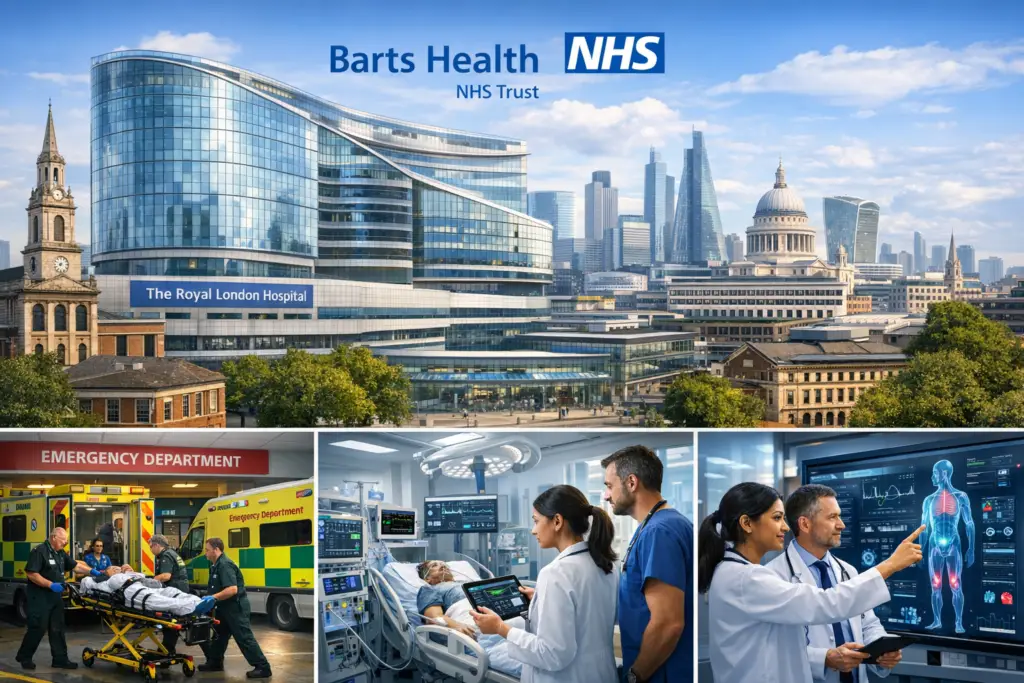
Barts and The London NHS Trust
Establishment
Based in England, this Trust was established in 2012. It is recognized as one of the largest and most renowned hospital trusts in England. It was formed through the merger of two major hospital trusts: Barts and The London NHS Trust, and Whipps Cross University Hospital NHS Trust.
In addition to these, the Trust encompasses several other hospitals, such as St Bartholomew’s Hospital, The Royal London Hospital, and Whipps Cross Hospital.
From its inception, the primary objective of this Trust has been to provide high-quality medical services to the residents of East London and the surrounding areas. Since the very beginning, it has focused on optimizing its resources, refining treatment methodologies, and delivering excellent patient care.
History
The history of this institution spans many centuries. St Bartholomew’s Hospital is considered the oldest constituent of this Trust, having been founded in 1123 AD. It stands as one of the oldest hospitals in Europe.
Concurrently, The Royal London Hospital was established in the 18th century—specifically around 1740 AD—and is renowned for its emergency services and trauma care. Over time, the hospital has evolved significantly; today, its scope extends beyond clinical care to encompass medical education, research, and advanced treatment modalities.
Between the 20th and 21st centuries, the growing population led to an increased demand for medical services. Consequently, the organization underwent restructuring into various smaller and larger entities, ultimately culminating in the formation of the current Trust in 2012.
Infrastructure and Facilities
Modern Buildings
The building has been constructed with structural integrity and incorporates modern technology, ensuring a hygienic environment and paying special attention to the specific needs of patients.
Additionally, a dedicated waiting area has been provided to ensure that family members accompanying patients experience no inconvenience.
Medical Department
The Medical Department offers facilities such as CT scans, X-rays, robotic surgery, laboratory testing, and MRI services. These resources enable specialist doctors to obtain precise diagnostic information regarding various ailments.
Emergency Department
In this department, a dedicated team of doctors and nurses remains on standby 24 hours a day to provide medical care. Immediate treatment is administered for emergencies such as accidents or sudden medical conditions, including heart attacks. Furthermore, the department is equipped with state-of-the-art machinery and staffed by trained personnel.
ICU
This department is equipped with facilities such as ventilators and advanced monitoring systems, enabling the safe and efficient treatment of critical and complex medical conditions.
Departments and Specializations
Neurology
This department is dedicated to the diagnosis and treatment of diseases related to the brain and the nervous system. Conditions such as strokes, epilepsy, Parkinson’s disease, and brain tumors are treated here. Additionally, the department offers diagnostic facilities such as CT scans, MRIs, and EEGs.
Oncology
This department focuses on cancer research and treatment. Here, conditions such as lung cancer, blood cancer, and breast cancer are treated using methods including chemotherapy, radiotherapy, and surgery.
Orthopedics
This department addresses diseases and conditions related to bones and joints—such as fractures, arthritis, and spinal issues. To provide solutions, specialist doctors utilize procedures such as joint replacement surgery and physiotherapy.
Gastroenterology
This department is established to treat diseases affecting the digestive system. This includes conditions such as liver disease, ulcers, and various gastric disorders. For diagnostic purposes, doctors utilize procedures such as endoscopy and colonoscopy.
Other Major Departments
In addition to the above, the facility houses departments for Respiratory Medicine, Pediatrics, Emergency Services, Trauma Care, Radiology, Pathology, Dermatology, Psychiatry, and Urology.
Doctors and Medical Staff
1. Doctor Qualifications
To become a doctor, one must obtain a degree such as an MBBS; furthermore, to practice in the UK, registration with the GMC is mandatory. Only after fulfilling these prerequisites does a doctor pursue specialization (such as an MD or MS) or undergo further professional training. In this hospital, the primary responsibility of the doctors is to thoroughly examine patients, provide appropriate medical treatment, and perform surgeries when necessary.
2. Nursing Staff
Nurses play a pivotal role in this hospital. To qualify as a nurse, one must first obtain a degree—such as a B.Sc. in Nursing—or a relevant diploma. Subsequently, the nursing staff registers with the appropriate medical council. Nurses administer medications to patients, provide care and supervision, verify patient details, and assist doctors during surgical procedures. They also offer guidance and counseling to patients and their families.
3. Technicians
To join the staff as a technician in this hospital, an individual must hold a degree or diploma in Science or Engineering. The duties of a technician involve operating medical equipment, conducting diagnostic tests, and preparing patient reports.
Patient Care Services
1. OPD Services
OPD (Outpatient Department) is a service where patients do not require admission to the hospital. Here, patients schedule direct appointments with doctors for examinations, consultations, and follow-up visits. The OPD department houses various medical specialists who provide expert treatment for a wide range of ailments. If a patient’s condition is not severe, they are discharged and sent home on the very same day.
2. Emergency Services
The Emergency Ward at this hospital remains open 24 hours a day to serve patients. It provides immediate medical treatment for critical situations such as accidents, severe injuries, heart attacks, or sudden onset illnesses. The Emergency Ward is staffed by trained doctors and nurses who initiate treatment rapidly to help save the patient’s life.
3. Ambulance Services
This hospital also provides ambulance services for its patients. In emergency situations, the ambulance service ensures the safe and rapid transport of patients from their homes or the scene of an accident to the hospital. The hospital’s ambulances are equipped with various life-saving devices and carry a medical team that begins administering primary medical aid to the patient while en route.
4. Pharmacy Services
This hospital features an in-house pharmacy service that dispenses all medications prescribed by doctors to patients, offering them at reasonable rates. The pharmacy staff provides patients with clear instructions on the correct method of taking their medications. Additionally, they educate patients regarding the potential effects of the drugs and any necessary precautions to observe.
Technology and Digital Equipment
1. Modern Machinery
This hospital is equipped with various types of modern machinery, facilitating procedures such as MRI scans, CT scans, robotic surgeries, and advanced cancer treatments. With the aid of these machines, doctors can easily visualize internal bodily ailments, thereby enabling them to provide effective treatment. Furthermore, the use of this technology ensures that robotic surgeries are safer, painless, and facilitate a quicker recovery for the patient.
2. Digital Records
This hospital utilizes digital record-keeping services to manage patient medical reports, ensuring that each patient’s complete medical history is stored digitally. This system allows doctors and other medical staff to access patient information with just a single click, thereby significantly aiding them in the treatment process.
3. Telemedicine
The hospital offers telemedicine services to its patients. Through telemedicine, patients can consult with doctors via video calls from the comfort of their own homes. This service is particularly beneficial for individuals who are unable to visit the hospital—whether due to geographical distance, travel constraints, or advanced age—making it an extremely useful resource for these specific groups.
Community and Social Works
The primary objective of this trust is to foster a healthy life for the community. The trust operates specifically within the East London boroughs of Tower Hamlets, Newham, Hackney, and Waltham Forest, providing essential healthcare services.
1. Community Health Services
The trust offers a wide range of health services, including specialized care in fields such as neurology and diabetes. Its services extend beyond hospital settings to encompass surrounding neighborhoods, local community centers, and clinics, thereby empowering everyone to lead a healthy lifestyle.
2. Community Work for Health Program
The goal of this program is to reduce health inequalities. Under this initiative, residents of the local area are provided with opportunities for training, mentorship, and employment. A particular focus is placed on preparing underprivileged and needy individuals for employment within the NHS. This not only secures employment for individuals but also provides them with the opportunity to contribute to the delivery of healthcare services.
3. Youth and Education Programs
The trust runs various initiatives, such as the “Healthcare Horizons” program. These programs educate and train young people and students in the field of healthcare. This provides many students and youths with a clear sense of direction, guiding them toward future engagement and careers within the healthcare sector.
4. Social Support for Specific Groups
Through programs such as “Project SEARCH,” the trust provides specialized assistance to individuals with disabilities and the elderly.
Challenges and Problems
This trust faces numerous challenges and problems while providing assistance to the public.
1. The Growing Number of Patients
As this trust is highly renowned, the number of patients visiting its hospitals continues to rise steadily. This makes it difficult to provide adequate services effectively. According to reports, the patient count increases year after year; consequently, many patients face prolonged waiting periods for treatment—particularly those requiring elective surgeries and cancer diagnostics.
2. Financial Constraints
Due to its limited budget, the trust struggles to strike a balance between its expenditures and available funds, thereby creating a persistent risk of a financial deficit. Consequently, economically vulnerable patients often feel apprehensive about seeking medical treatment.
3. Cybersecurity and Data Security Risks
Recently, in 2025, the trust experienced a data breach that resulted in the leakage of patients’ private information. This incident serves as a stark reminder that cybersecurity constitutes a major challenge within the healthcare sector.
Future Plans and Vision
In the coming times, the Trust is focusing its efforts on establishing a patient-centered healthcare system and enhancing the effectiveness of healthcare delivery. The aim is to ensure that, in the future, patients can access high-quality healthcare services even at the community level.
1. Care Closer to Home
In the future, the Trust intends to extend hospital-grade facilities and services to the community level. The objective is to deliver hospital-quality care directly to patients in their homes. This initiative will help alleviate the increasing burden on hospitals by enabling patients to receive comprehensive medical care within the comfort of their own homes.
2. The Goal of Excellence and Innovative Healthcare
The Trust is actively working towards the goal of providing innovative healthcare solutions. This entails ensuring that patients receive treatment utilizing the most advanced modern technologies available. Future efforts involve conducting research into new technologies, as well as adopting novel techniques and enhanced clinical practices to significantly improve healthcare outcomes.
3. Reducing Health Inequalities
Health inequality remains a major challenge in economically disadvantaged regions, such as East London. The Trust is committed to reducing these health disparities and ensuring that equitable healthcare services are accessible to all members of the community. To achieve this, the organization is actively strengthening its public health initiatives and fostering robust community partnerships.