
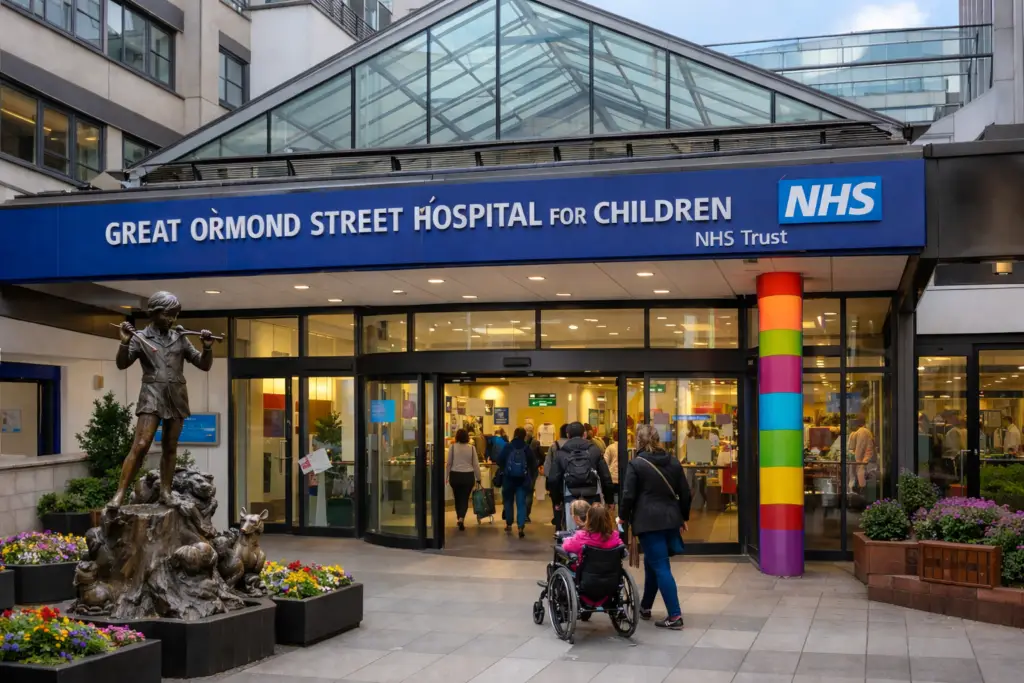
Great Ormond Street Hospital for Children NHS Trust
Establishment
Great Ormond Street Hospital for Children, also known as GOSH, is located in London and was established in 1852. As is evident from its name, this hospital was created primarily for the treatment of children.
Initially, it was merely a small healthcare center comprising 10 beds and offering limited medical services. However, owing to the quality of its care, the hospital underwent rapid expansion over time.
The renowned physician Charles West laid the foundational groundwork for this hospital, which is today recognized globally for its contributions to research and training.
History
The history of this hospital spans many years. It is well known that, in its early days, the institution faced financial constraints; however, as time progressed, it began to grow, and its medical resources gradually improved.
The celebrated author J.M. Barrie donated the entire proceeds from his famous book, *Peter Pan*, to this hospital. This contribution provided significant support to the institution and helped spread its reputation across the globe.
From the very beginning, it was Charles West’s vision to establish a hospital dedicated exclusively to providing safe and effective medical care for children—a vision that has today resulted in an institution renowned worldwide.
Infrastructure and Facilities
Modern Buildings
The hospital building has been constructed utilizing modern technology; consequently, people regard its infrastructure as highly advanced and well-organized. Special attention has been paid here to the specific needs of children, for which a unique environment featuring colorful designs has been created. Various specialized departments have been established to address the diverse range of pediatric ailments, ensuring that children receive prompt and safe medical treatment.
ICU Department
This department is divided into two distinct sections: the NICU (Neonatal Intensive Care Unit), dedicated to newborn infants, and the PICU (Pediatric Intensive Care Unit), designed specifically for older children. To facilitate their treatment, the unit is equipped with modern medical machinery—including advanced monitoring systems, ventilators, and various other life-saving devices.
Emergency Department
In this department, doctors and nurses are available 24 hours a day to attend to children suffering from critical illnesses, ensuring that they receive timely medical intervention. Additionally, comprehensive provisions have been made for ambulance services, trauma care, and diagnostic testing facilities.
Medicine Department
Within this department, doctors and support staff work on pioneering new treatment modalities and diagnosing rare or unidentified diseases. The department is equipped with state-of-the-art facilities, including robotic surgery capabilities, gene therapy services, and a high-tech diagnostic laboratory.
Facilities for Family Members
In addition to caring for the children, the hospital places great emphasis on the well-being of their families, providing high-quality amenities such as waiting areas, a cafeteria, a children’s play area, and support groups. These spaces allow parents to spend quality time with their children, thereby contributing to a faster and more positive psychological recovery process.
Departments and Specializations
Pediatrics
As is well known, this Trust was established primarily for the care of children. This department places special emphasis on addressing health and developmental issues ranging from newborns to adolescents.
Neurology
In this department, conditions affecting children’s brains and nervous systems—such as epilepsy, brain tumors, neuromuscular disorders, and various other ailments—are treated with the assistance of expert physicians.
Cardiology
This department specializes in the treatment of heart-related conditions in children, including congenital heart defects. Expert physicians utilize procedures such as cardiac surgery and interventional cardiology for treatment.
Oncology
Children suffering from cancer receive treatment in this department, which involves procedures such as chemotherapy, radiotherapy, and bone marrow transplantation.
Orthopedics
This department is dedicated to the treatment of conditions affecting the bones and muscles, including fractures, congenital deformities, and spinal disorders.
Other Key Departments
In addition to the above, this hospital offers a comprehensive range of services including Genetics, Respiratory Medicine, Gastroenterology, Nephrology, Immunology, Surgery, Intensive Care, Psychology, Dermatology, Mental Health, and Transplant Services.
Doctors and Medical Staff
1. Doctor Qualifications
Hospital doctors are required to hold a degree such as an MBBS. Only after obtaining this degree can they pursue postgraduate qualifications—such as an MD or MS—to specialize in specific fields, such as Pediatrics, Cardiology, Neurology, or Oncology (Cancer Treatment). Furthermore, to practice in the UK, it is mandatory for doctors to register with the General Medical Council. The primary responsibilities of these doctors include diagnosing patients’ illnesses, formulating appropriate treatment plans, performing surgeries, and explaining the nature of the illness and the treatment process to the parents of pediatric patients.
2. Nursing Staff
The nursing staff plays a pivotal role in this hospital. To become a nurse, one must obtain a nursing qualification, such as a B.Sc. in Nursing or a Nursing Diploma. These nurses undergo specialized training specifically focused on the care of children. The duties of a nurse involve providing daily care to patients, administering medications, and continuously monitoring the patient’s condition. Nurses also assist doctors during surgical procedures.
3. Technicians
Technicians at this hospital typically hold degrees in Biomedical Science or Medical Technology. The role of a technician involves operating the modern medical equipment installed within the hospital, conducting laboratory tests, and providing accurate diagnostic reports to the doctors.
Patient Care Services
1. OPD Services
The OPD (Outpatient Department) is a section where patients do not require admission to the hospital. Here, patients first complete their registration and subsequently schedule an appointment with a doctor. The doctor examines their condition, offers medical advice, and prescribes necessary medications. The OPD houses various medical specialists across disciplines such as Cardiology, Neurology, and Oncology (Cancer Care).
2. Emergency Services
The Emergency Ward at this hospital remains open 24 hours a day to serve patients. Immediate medical treatment is provided in the Emergency Ward for critical illnesses or sudden accidents. A team of highly trained doctors and nurses in the Emergency Ward conducts rapid assessments to save the patient’s life and ensure their safety.
3. Ambulance Services
This hospital also provides ambulance services to its patients, facilitating rapid transportation either from home to the hospital or for transfers between medical facilities. The hospital’s ambulances are equipped with modern medical instruments and various life-support devices; they are staffed by trained paramedics who initiate primary medical care en route to ensure the patient’s condition remains stable and free from further risk.
4. Pharmacy Services
A pharmacy facility is available within the hospital premises, where patients can procure all medications prescribed by their doctors at reasonable rates. The pharmacists provide guidance on the correct usage and relevant information regarding the medications to help ensure the patient’s speedy recovery.
Technology and Modern Machinery
1. Modern Machinery
This hospital is equipped with various types of modern machines and offers advanced diagnostic services—such as MRI scans, CT scans, PET scans, robotic surgical systems, and advanced laboratory technology. With the aid of these tools, doctors are able to diagnose pediatric illnesses quickly and accurately. The hospital also features high-tech operation theaters designed to facilitate various complex surgical procedures.
2. Digital Records
This hospital utilizes digital records to store patients’ medical reports and test results. Through this system, a patient’s entire medical history is securely saved within a computer database, allowing doctors, nurses, and other medical staff to access past medical reports with just a single click. This facilitates faster and more accurate treatment. Furthermore, digital records enable the easy management of information regarding medications, diagnostic reports, and treatment plans.
3. Telemedicine
This hospital provides its patients with secure telemedicine services. Through telemedicine, patients can consult with a doctor and undergo a virtual examination via video call—whether they are at home or traveling elsewhere. Doctors provide medical advice and prescribe medications directly through these video consultations. Telemedicine services allow patients living in remote areas to receive guidance from specialist doctors; this service is particularly beneficial for the elderly.
Community and Social Work
The social workers associated with this trust have not limited their services solely to the hospital premises; rather, they have extended their outreach directly into the community to provide assistance.
1. Emotional and Social Support
The trust’s social workers provide emotional support to the families of patients. They offer services—such as counseling—aimed at alleviating the stress, anxiety, and fear associated with illnesses, thereby helping families gain mental resilience.
2. Social and Financial Assistance
This trust operates and facilitates various services designed to provide financial aid to patients. They provide information regarding welfare benefits, financial assistance, and other support services, with the aim of reducing the financial burden on the families.
3. Safeguarding and Practical Support
A crucial aspect of the social work undertaken here is ensuring the safety and protection of children. Additionally, families are provided with practical support regarding accommodation, travel arrangements, and their daily necessities.
Challenges and Problems
This hospital frequently faces various problems and challenges.
1. Increasing Number of Patients and Complex Diseases
At GOSH, the number of children suffering from severe and rare diseases continues to rise steadily every year. These conditions are such that their treatment is highly complex and time-consuming. Consequently, the efficient management of resources becomes a challenging task. Furthermore, this leads to an increased workload and heightened pressure on the hospital.
2. Work Pressure on Staff
Due to a shortage of specialist doctors, nurses, and skilled social workers within the hospital, the work pressure on the staff intensifies. As a result of understaffing—often involving excessive work and long hours—employees frequently face issues such as emotional stress and burnout. This can potentially compromise the quality of the services they provide.
3. Funding and Resource Constraints
Due to a limited budget, it becomes difficult to maintain modern medical treatments, new technologies, and support services. Often, budgetary constraints act as a barrier to providing essential facilities and meeting necessary requirements.
4. Emotional and Financial Impact on Families
Frequently, due to prolonged treatment periods and extended hospital stays, families are compelled to cope with significant mental stress and financial burdens. It is not always possible for every family to access the financial assistance they require, which further exacerbates their difficulties.
Future Plans and Vision
This hospital is actively conducting research into various new technologies and state-of-the-art treatments—often in conjunction with AI—to ensure that patients receive faster and more effective care in a timely manner.
1. Enhanced and Connected Care System
The Trust aims to provide children with seamless and connected care. The hospital is currently developing a system designed to extend healthcare services beyond the confines of the hospital walls—reaching into the community and patients’ homes—thereby making treatment more accessible and expediting the healing process.
2. Promoting Innovation and Research
The objective is to accelerate the translation of innovation and research findings into clinical practice in the near future. This will facilitate improved treatment for rare diseases through advanced therapies, while simultaneously ensuring faster and better outcomes for children.
3. Utilization of Digital and AI Technologies
Moving forward, GOSH is championing the integration of Artificial Intelligence (AI) and digital technologies to accelerate diagnostic processes, enable personalized treatment plans, and enhance the overall efficiency of hospital operations.
4. Staff Development and Global Collaboration
The Trust is prioritizing the training, skill enhancement, and well-being of its staff to further optimize their performance. Furthermore, it is actively sharing knowledge through international partnerships and collaborations, with the ultimate goal of improving pediatric healthcare standards on a global scale.